 YesNoButton
The History of the Magic 8-Ball, and Why Humans Still Crave Random Answers
Written by Kapil Yadav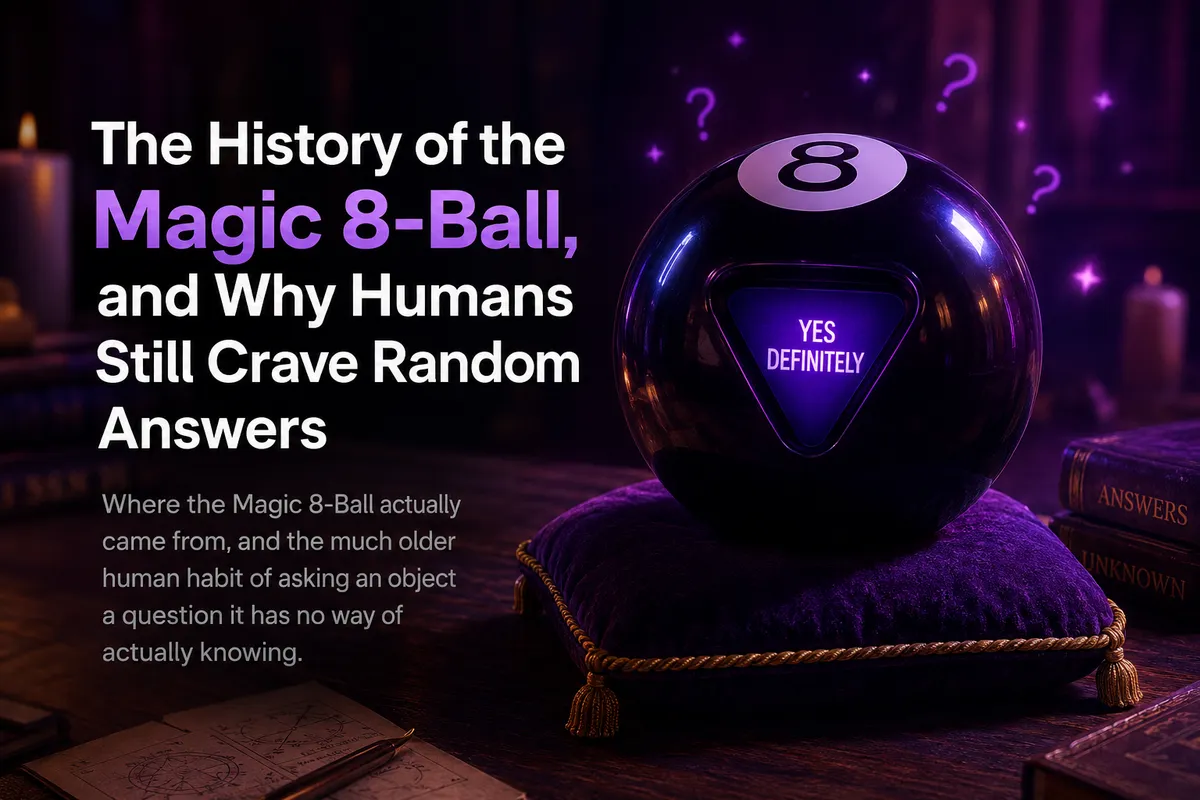
Shake the ball, ask your question, turn it over, and wait for the little window to clear. It is a strange ritual when you think about it: a plastic sphere filled with liquid has no idea what you just asked it, and yet the answer still feels like it means something. That feeling is not a design accident. It is the same instinct that has driven people to consult coins, cards, and bones for thousands of years, just packaged in a toy that happened to become a cultural icon.
Where It Actually Came From
By most accounts of its origin, the idea behind the Magic 8-Ball traces back to a fortune-telling device built decades earlier by a clairvoyant named Mary Carter. Her son, Albert C. Carter, later worked with businessman Abe Bookman to adapt the concept into a sealed, liquid-filled sphere with a twenty-sided die floating inside, each side printed with a short answer: some affirmative, some negative, some deliberately noncommittal, like “reply hazy, try again.” The two men’s company, built from a combination of their names, brought the design to market in the years after World War II, originally aimed at adults as a novelty desk item rather than a children’s toy.
The 8-ball shape itself was reportedly a marketing choice more than a mystical one, tying the product to the language of pool and giving it an instantly recognizable silhouette. Over the following decades, ownership of the product passed through several toy companies, and it eventually became one of the best-known items in Mattel’s catalog. The exact answer wheel has stayed largely unchanged this whole time: the same twenty phrasings, the same blue liquid, the same deliberate mix of yes, no, and maybe.
A Much Older Habit Than Plastic and Liquid
Handing a decision to an object that cannot possibly know the answer is a very old human behavior. Cultures across history have cast lots, thrown bones, drawn straws, and consulted the sixty-four hexagrams of the I Ching to decide everything from small daily choices to major political and military decisions. Coin flipping for a fair, binary outcome shows up across centuries and continents, long before anyone thought to put a plastic die inside a ball. The specific object changes. The underlying need does not: people have always wanted a way to force a decision that nobody in the room can be blamed for.
Why We Still Do This With a Screen Now
A digital yes or no tool is doing exactly the same job the 8-ball did, just without the liquid and the shaking. The appeal was never really about the object having secret knowledge. It is about creating enough psychological distance from a decision that you can finally react to it honestly. When an outside source proposes an answer, you get to notice your own gut reaction to it, relief or disappointment, before you have had time to talk yourself into the “correct” response. That reaction is usually more informative than the random result itself, and it is a large part of why this style of decision-making has survived every possible upgrade in technology, from bones to plastic balls to a button on a phone screen.
The Difference Between a Toy and a Tool
None of this depends on the object having any actual insight. A Magic 8-Ball, a coin, and a modern yes no oracle are all running on the same simple mechanism: a genuinely random, unbiased split between two outcomes. What makes any of them useful is not mystical accuracy. It is the honest reaction they provoke in the person asking the question. Treated that way, an old plastic toy and a modern web tool are doing the exact same job, just decades apart.
Frequently Asked Questions
Was the Magic 8-Ball originally invented for children?
No. By most historical accounts, it was first marketed to adults as a novelty item, and only became known primarily as a children’s toy later in its history.
How many possible answers does a Magic 8-Ball give?
The classic design uses a twenty-sided die with twenty distinct printed answers: a mix of affirmative responses, negative responses, and noncommittal ones that ask the person to try again later.
Is a digital yes or no tool basically a modern Magic 8-Ball?
Functionally, yes. Both rely on a genuinely random, unbiased split between outcomes. The value in either case comes from your own reaction to the answer, not from the object having any real insight into your situation.
Why do people still enjoy asking an object for an answer instead of just deciding themselves?
It removes the discomfort of feeling solely responsible for a choice, especially a low-stakes one, and it creates a moment of honest reaction that is often clearer than reasoning the decision out loud.
Want the modern version?
No shaking required. Ask your question and get an instant answer.
Consult the Yes No Oracle →