 YesNoButton
The Ultimate 'What Should We Eat Tonight' Decision Guide
Written by Kapil Yadav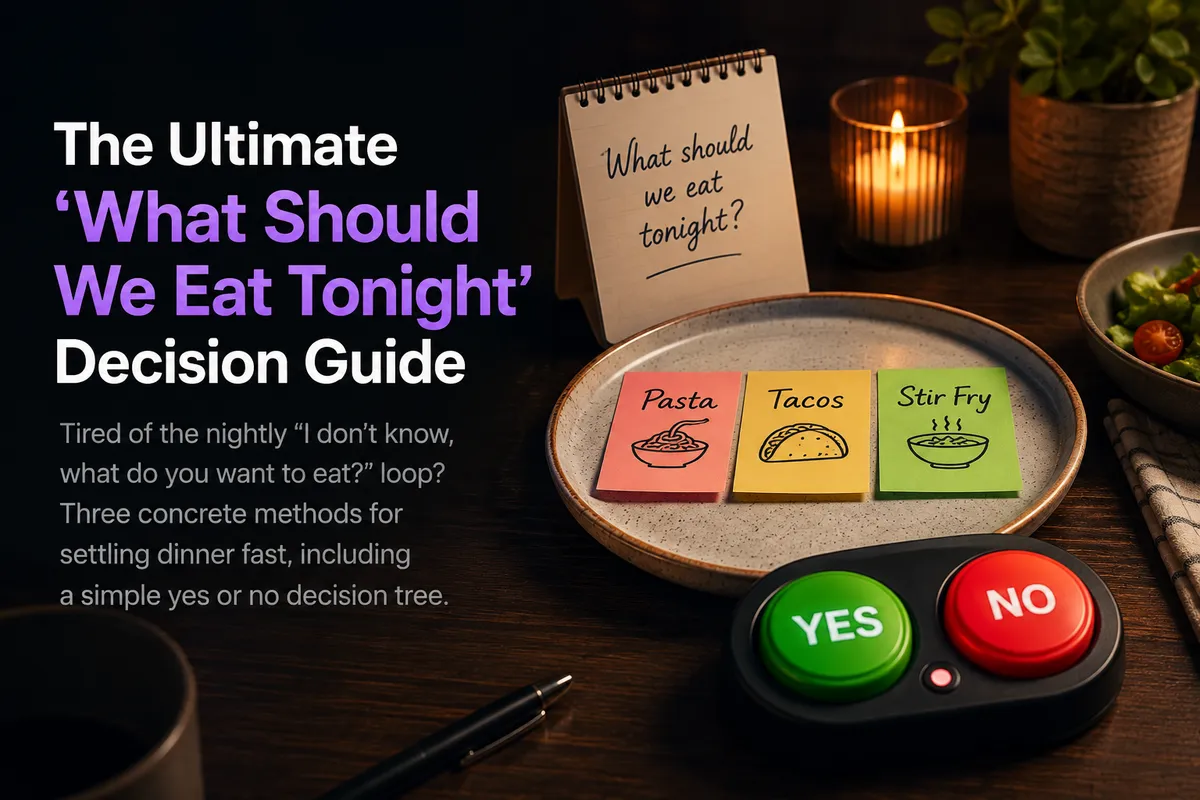
It happens almost every evening. Someone asks what’s for dinner. The other person says they don’t know, what do you want. Nobody wants to answer first, because whoever picks is the one who gets blamed if the meal turns out to be a bad idea. Ten minutes later, nothing has been decided and everyone is hungrier and more irritable than when the conversation started.
This is not really a food problem. It is a decision problem, made worse by the fact that there are functionally unlimited options and nobody wants to be responsible for choosing among them. Here are three concrete ways to actually get out of the loop.
Use the Yes No Button to make the final call
Try the Yes No Button →
Why “What Do You Want” Never Works
Asking an open question with unlimited possible answers is the worst way to start a decision. There is no wrong answer to filter against, so the conversation just circles. The fix is always the same: turn an open question into a narrow one before you try to decide anything. Every method below does this in a different way.
Method One: The Elimination Round
Say five realistic options out loud, one at a time, no matter how obvious or repetitive they feel. Each person gets to veto exactly one option per round, no explanation required. Keep going until one option is left standing. This works because vetoing feels much lower stakes than proposing, so people who normally refuse to pick anything will happily cross an option off the list.
Method Two: The Yes or No Decision Tree
This is the fastest method if you are deciding alone or nobody wants to name specific restaurants out loud. Instead of trying to jump straight to an answer, ask yourself a chain of yes or no questions, each one narrowing the field, and press the button for any question you genuinely cannot answer:
- Cook, or order? If you’re stuck, let the button decide.
- If ordering: delivery, or pick it up yourself?
- If cooking: something already in the fridge, or a trip to the store?
- Something you’ve made before, or something new?
- Heavy meal, or something light?
By the time you’ve answered four or five of these, you are not choosing between thousands of possible meals anymore. You are choosing between two or three, which is a decision your brain can actually make quickly.
Method Three: The Two Finalists Flip
If you already have a rough idea and just can’t commit, name your top two options out loud, assign one to yes and one to no, and press the button once. Pay attention to your first flicker of reaction before you consciously think about it. If the button lands on the option you don’t want and you feel a small wave of relief, not disappointment, that tells you something real: you already knew which one you wanted, you just needed permission to admit it.
For Couples and Roommates: Rotate Who Proposes
A common trap in shared households is that the same person always ends up naming the two finalists, which quietly puts all the decision fatigue on one person night after night. Rotate it: one night, one person names the two options and the other picks or flips; the next night, switch. It keeps the mental load of “what should we eat” from becoming one person’s permanent, invisible job.
When Nobody Can Agree at All
If elimination rounds keep ending in a draw and nobody will commit to two finalists, skip straight to a single random decision instead of letting the conversation drag on. Write down three or four fair, realistic options, assign each a range on a scale, and use the Yes No Wheel or button to force a fair, fast pick. A slightly-less-than-perfect dinner decided in ten seconds beats a great dinner idea that took twenty-five minutes of debate to reach.
Frequently Asked Questions
What’s a fast way to decide what to eat when nobody has any ideas?
Start with the yes or no decision tree above: cook or order, delivery or pickup, familiar or new. Each answer cuts the number of realistic options roughly in half, so you reach a specific choice in a handful of quick questions instead of trying to think of the “right” meal from scratch.
How do we stop one person from always being the one who decides?
Rotate who proposes the final two options each time you use the elimination or two-finalists method. This spreads the actual decision-making work evenly instead of leaving it with whoever happens to speak first.
Is it worth using a random tool for something as small as dinner?
Yes, precisely because it’s small. Dinner is exactly the kind of low-stakes, recurring decision that eats up disproportionate mental energy for how little it actually matters. Outsourcing it to a quick random result frees up that energy for decisions that actually deserve it.
What if the random result feels wrong once it lands?
That reaction is useful information, not a mistake. If a result makes you feel a flicker of disappointment, you probably already had a preference. Notice it, override the result, and go with what you actually wanted. The point of the tool is to surface that reaction quickly, not to be obeyed no matter what.